


How Environment Shapes Our Circadian Health
- Sep 19, 2025
- 4 min read
Step into a casino at midnight, and you’ll lose all sense of time. No windows, no clocks, just flashing lights and endless stimulation. Really fun, pretty lights though…right? Hours pass unnoticed until fatigue finally crashes over you. That’s by design, not an accident. Environments can either support or sabotage our biological rhythms, and modern life often tilts toward the latter.
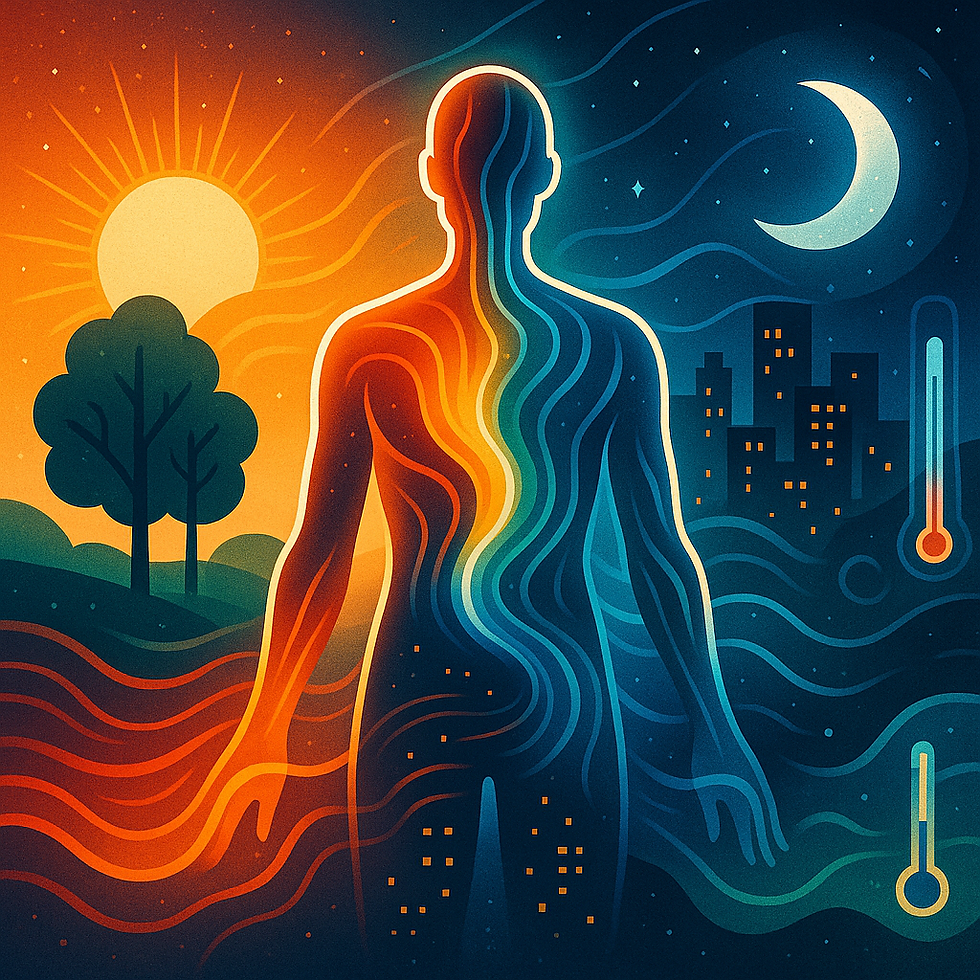
Circadian health, which is the synchronization of our internal clocks with the external world, depends on environmental cues. Light, temperature, noise, and even the layout of the spaces we spend time in signal our nervous system: safe or unsafe, day or night, act or rest. When those signals get scrambled, performance frays.
What is Circadian Health?
Circadian health refers to the alignment of our body’s internal 24-hour rhythms with the cycles of light and dark in our environment. At its core is the suprachiasmatic nucleus (SCN), a tiny brain structure that keeps track for the rest of our body. It regulates when hormones like melatonin rise, when cortisol dips, and when body temperature shifts.
When the SCN is in sync with the world around us, sleep feels restorative, focus is sharper, and energy flows predictably across the day. When it’s out of sync, such as when we experience jet lag, late-night scrolling, or shift work, our whole body gets disrupted. We feel groggy, unfocused, or “wired but tired.”
Circadian health, then, isn’t just about bedtime. It’s about whether our biology is moving in rhythm with our surroundings.
Why Environment Tunes the Clock’s
Light is the single most powerful environmental cue for circadian alignment. Natural morning light tells the brain it’s daytime, suppressing melatonin and elevating alertness. Evening darkness does the opposite, signaling the body to prepare for sleep.
Our modern environment often sends mixed signals. Blue light from screens tricks the brain into thinking it’s still day. Bright lights at night delay melatonin release. Conversely, working in dim offices during daylight hours can dull the system, leading to afternoon crashes.
Other environmental factors also nudge the circadian clock. Our internal temperature naturally drops at night, supporting sleep onset, but warm rooms delay that necessary drop. Noise pollution raises cortisol, keeping the nervous system alert even when the clock says rest. Air quality and even scent play subtle roles in whether the body interprets an environment as safe for restoration.
Our circadian health isn’t just a matter of willpower. It’s a dialogue between the body and the spaces it inhabits.
What Happens When Rhythms Break Down?
When environmental cues and circadian rhythms misalign, the costs ripple across our entire psychophysical system. Short-term, this shows up as poor sleep, slower reaction times, and mood swings. Long-term, chronic circadian disruption raises risks for cardiovascular disease, metabolic disorders, depression, and even certain cancers.
The nervous system interprets circadian mismatch as stress. Cortisol stays elevated longer than it should. The immune system weakens. Inflammation rises. Athletes feel it as slower recovery; professionals feel it as brain fog and irritability. The body is no longer sure when to repair and when to perform.
Circadian breakdown isn’t a signal of laziness or lack of discipline, at least not directly. At it’s essence, it’s biology trying to function without clear signals.
Athletes, Shift workers, and Night Owls: Different Rhythms, Same Rules
Elite athletes often structure training around circadian rhythms, timing workouts to match peaks in body temperature and neuromuscular efficiency. A late-afternoon sprint session may feel smoother than one at dawn, not because of mindset but because the body is literally wired for performance at that time.
Shift workers, by contrast, battle constant circadian misalignment. Working through the night and sleeping through the day means fighting against the SCN’s natural rhythm. Research shows higher rates of accidents, injuries, and chronic illness in these populations due to environmental mismatch.
Even self-proclaimed “night owls” aren’t immune. While genetic variation does create early birds and late risers, consistent exposure to artificial light can exaggerate the tendency, making it harder to sync with a 9-to-5 world.
How to Realign the System
Like nearly all aspects of the human body, circadian systems are plastic. With consistent cues, they recalibrate. Morning light exposure is one of the most effective tools, and just 10–20 minutes of natural sunlight after waking helps anchor the body’s clock. Evening darkness matters just as much. Dimming lights, reducing screen exposure, and lowering room temperature all signal the nervous system that it’s time to downshift.
Small environmental tweaks go further than willpower alone. Opening blinds during the day, stepping outside for breaks, setting cooler nighttime temperatures, and using warm light in the evening all provide biological guidance. The body is responsive if we ask it to be. It just needs clarity.
Environment and Circadian Health as Performance Science
In performance terms, circadian alignment is not optional. It’s the foundation. A misaligned clock leaves athletes slower, professionals foggier, and recovery delayed. When environment and rhythm align, the system purrs, and sleep is deeper, focus is sharper, and resilience builds almost automatically.
Think of it less as “biohacking” and more as returning the body to the design it evolved for – sunrise, sunset, cycles of effort and rest. Our modern lives may confuse those signals, but with awareness, we can tune the environment we live in to let the clock keep time.
Health is about what we do but also where and when we do it. The body’s clock listens constantly to its environment, adjusting hormones, attention, and energy in response. When we shape environments that support circadian health, we’re not just helping ourselves sleep better. We’re giving the whole system a stage on which resilience, focus, and performance can actually play out.
References
Czeisler, C. A., & Gooley, J. J. (2007). Sleep and circadian rhythms in humans. Cold Spring Harbor Symposia on Quantitative Biology, 72, 579–597.
Wright, K. P., Jr., et al. (2013). Entrainment of the human circadian clock to the natural light-dark cycle. Current Biology, 23(16), 1554–1558.
Haus, E. L., & Smolensky, M. H. (2013). Biological clocks and shift work: circadian dysregulation and potential long-term effects. Cancer Causes & Control, 24(4), 749–761.
Foster, R. G., & Kreitzman, L. (2014). Circadian Rhythms: A Very Short Introduction. Oxford University Press.
LeGates, T. A., Fernandez, D. C., & Hattar, S. (2014). Light as a central modulator of circadian rhythms, sleep, and affect. Nature Reviews Neuroscience, 15(7), 443–454.


