


Performance and Well-Being: Neglected Factors That Shape How We Feel
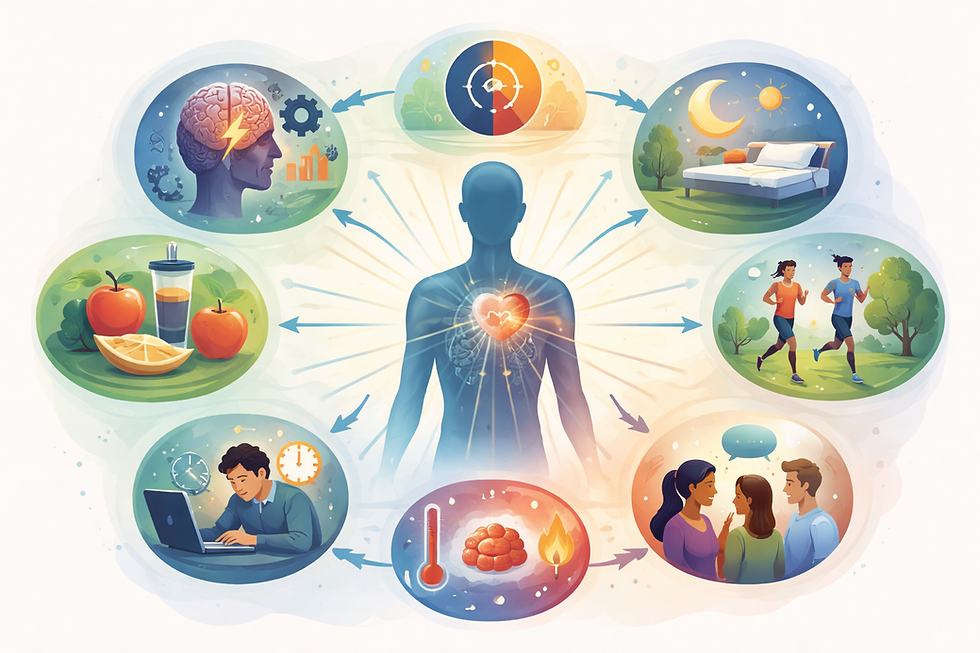
How we feel day-to-day, what we’ll call our “state,” emerges from countless interactions within our mind and body, often operating simultaneously. Training volume, nutrition, and sleep are inputs we’re likely familiar with, but they don’t operate in isolation. Cognitive demand, nervous system tone, environmental signals, inflammatory activity, recovery efficiency, and other factors all modulate how those inputs are expressed, and how we show up in life.
When these background variables are elevated, our body reallocates resources toward maintenance and protection. That reallocation changes how effort feels, how quickly recovery occurs, and how stable our attention and mood are. These effects are measurable and predictable, even when “standard” health markers fall within our normal ranges. This article takes a slightly different form than the usual ones because it’s meant to highlight some health factors that we might not think about on a regular basis.
It’s a bit science-heavy, but that’s by design to show there's bite behind the data. All of these factors are proven levers when it comes to health, but they tend to fly under the radar.
Cognitive Demand Is a Metabolic Cost
Neural activity consumes energy at a rate comparable to physical activity. The brain accounts for roughly 2% of body mass, but it is responsible for approximately 20% of our resting energy expenditure. If we do a rough estimate based on 2,000 calories a day, that’s 400 that go to powering our brain. It’s well spent because that energy supports attention, decision-making, working memory, and emotional regulation. Unlike skeletal muscle, neural tissue doesn’t store meaningful fuel reserves and depends on continuous glucose and oxygen delivery from the rest of the body.
Experimental data shows that sustained cognitive tasks increase cerebral energy consumption and alter neurotransmitter availability. In controlled studies, prolonged mental effort reduces physical endurance by 10–15% without changes in muscle strength, oxygen uptake, or cardiovascular output. In these endurance tests, our perceived effort seems to be the limiting factor, not physical fatigue. Just goes to show how much our thinking physically affects how we feel…in many ways.
Baseline Nervous System State
Our ability to recover largely depends on how efficiently our system returns to baseline after activation. Autonomic balance reflects the interaction between activation-oriented pathways and recovery-oriented pathways. One widely used proxy for this balance is heart rate variability (HRV), which measures beat-to-beat variation in heart rate. Higher variability indicates flexible regulation. Lower variability reflects persistent activation.
Chronic reductions in HRV correlate with elevated cortisol output, lighter sleep architecture, and slower tissue repair. These associations persist independent of aerobic fitness or training status. The determining factor is less about exposure to stressors and more the duration of physiological activation following them (i.e. do we process them and move on or not).
Environmental Signals as Biological Inputs
Light and sound directly influence endocrine and autonomic function. Melatonin secretion is sensitive to light exposure above approximately 30 lux. Typical indoor lighting ranges from 100 to 500 lux on average, greatly exceeding this threshold by a wide margin. Evening light exposure delays circadian phase, reduces REM sleep, and increases sleep fragmentation, often without altering our overall sleep duration.
Acoustic input exerts similar effects. Continuous background noise above ~40 decibels elevates sympathetic nervous system activity and stress hormone release, even in the absence of it being something we notice consciously. These signals are processed regardless of if we feel annoyed by them or not.
Social Context and Stress Chemistry
Social environments modulate hormonal load. Perceived social safety alters hypothalamic–pituitary–adrenal (HPA) axis activity. Laboratory and population studies show that supportive social contexts are associated with lower basal cortisol levels and reduced inflammatory signaling. One mediator is oxytocin, which reduces amygdala-driven threat responses and dampens stress reactivity.
Conversely, chronic social vigilance or isolation increases load, both physically and mentally. Things we do regularly with others produce higher stress hormone output when performed under conditions of perceived threat or lack of support.
Low-Grade Inflammation and State Regulation
Inflammatory signaling alters energy, motivation, and cognitive clarity without overt illness. Inflammation is not binary. Subclinical elevations in cytokines influence neurotransmitter metabolism and neural signaling efficiency (i.e. affect our brain in non-so-great ways sometimes). Studies show that restricting sleep to 4–5 hours per night over several days increases inflammatory markers by 30–50% for the majority of people, with parallel declines in alertness and task persistence.
Psychological stress and prolonged sedentary behavior produce similar inflammatory responses. These changes occur below diagnostic thresholds yet exert measurable effects on how we perceive fatigue, pain sensitivity, and mood stability.
Time Pressure as a Stress Load
Perceived urgency activates stress pathways independent of how urgent our workload truly is. Identical tasks performed under time constraints elicit higher cortisol responses than those performed without deadlines. The difference reflects threat appraisal rather than energy expenditure. Sustained urgency compresses parasympathetic recovery windows, reducing sleep depth and prolonging physiological activation (i.e. draining our battery more than if we didn’t feel urgency).
Over time, this pattern reduces our ability to recover efficiently, but rarely shows up as immediate performance loss. Output may remain stable while cost increases, leading to plateau and instability rather than failure. Only if not addressed for long enough do we start to risk full breakdown.
Self-Monitoring and Identity Load
Continuous self-monitoring consumes neural resources. Self-monitoring activates medial prefrontal networks associated with evaluation and rumination. Increased activation in these regions correlates with higher stress and reduced task efficiency. This processing represents cognitive work, drawing from the same metabolic pool as problem-solving or learning.
Reducing unnecessary self-evaluation decreases the cognitive load we feel without altering external demands. The effect is more along the lines of resource redistribution rather than behavior change, making it a lower-friction lever to pull.
Why These Variables Are Underrepresented
Many of these factors accumulate below clinical thresholds, and many times, below mainstream social-media “virality potential.”
Clinical frameworks, and often their consumer-facing derivatives, are optimized to detect disease and injury, not cumulative load that remains within “normal” ranges while altering functional output and how we actually feel.
As a result, individuals can present with normal biomarkers while experiencing persistent fatigue, reduced resilience, or unstable focus. Our physiology is intact. The system is simply operating under sustained load with no visible options out of it.
Performance and Well-Being
Everything improves when background load decreases. When cognitive demand, autonomic activation, environmental stress, and inflammation converge, our body conserves energy. That conservation shows itself as reduced drive, increased irritability, or slowed recovery, but these responses are adaptive, not dysfunctional.
Interventions that reduce baseline load often restore our overall well-being more effectively than those that increase effort or stimulus. The body responds consistently to cumulative demand. When the contributing variables are identified, how we feel becomes much more predictable rather than an ominous black box. Health, in this context, reflects alignment between load and recovery rather than strict adherence to isolated behaviors.
Understanding these mechanisms shifts the focus from optimization to calibration. Capacity is preserved not by pushing harder, but by reducing unnecessary cost.
References
Raichle, M. E., & Gusnard, D. A. (2002). Appraising the brain’s energy budget. Proceedings of the National Academy of Sciences.
Marcora, S. M., Staiano, W., & Manning, V. (2009). Mental fatigue impairs physical performance in humans. Medicine & Science in Sports & Exercise.
McEwen, B. S. (1998). Stress, adaptation, and disease: Allostasis and allostatic load. Annals of the New York Academy of Sciences.
Walker, M. P. (2017). Why We Sleep. Scribner.
Eisenberger, N. I., & Cole, S. W. (2012). Social neuroscience and health. Nature Neuroscience.
Cohen, S., et al. (2015). Social relationships and health. American Psychologist.
Thayer, J. F., & Lane, R. D. (2000). A model of neurovisceral integration. Journal of Affective Disorders.


