


Types of Motivation and Why Our Source of Drive is Paramount
Motivation is often framed as though it's a quantity problem or a root cause of problems. Too little and performance suffers, but too much and it burns hot, then collapses. The logic running underneath all of it is intuitive, framed like motivation is something we have more or less of, and managing it well means having enough at the right moments. What decades of research across sport, medicine, education, and organizational psychology keeps surfacing is something most advice and performance frameworks quietly sidestep.
Our level of motivation turns out to be far less predictive of long-term performance than where the motivation is actually coming from.
Two people can show up to the same demanding stretch of work with identical levels of apparent effort and commitment. One of them is running on something connected to who they are and what they value, leading to work that feels chosen and energizing even when it demands a lot. The other is running on fear of what happens if they stop. In the short term, there's often no visible difference and their outputs look similar. The level of motivation between the two people is seemingly identical. The difference happens on a deeper level and often takes time to show.
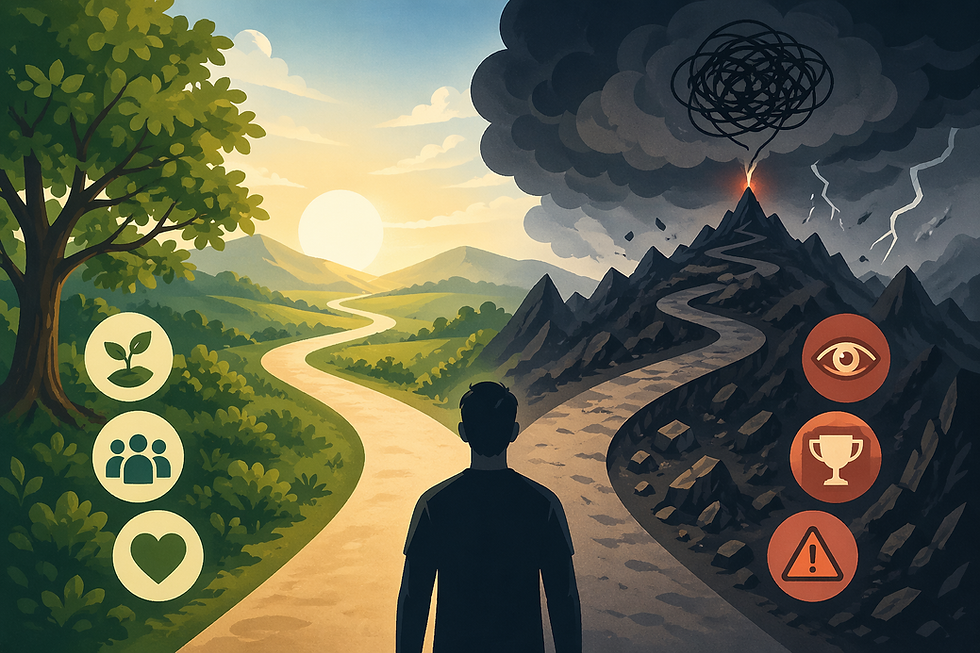
What Drives Our Drive?
Self-Determination Theory, which is a framework developed across four decades of research in psychology, draws a distinction between two fundamentally different types of motivation. The first type , autonomous motivation, is internally generated, meaning our actions connect to genuine interest and personal values and to who we are and what we care about. It feels like a choice even when the effort required is significant. The other type, controlled motivation, is organized from the outside in, meaning our behavior is driven by fear of what happens if we stop or by the need for external validation to feel like the work means something.
Activities we do with either type of motivation might look identical, but the internal structure generating them and their impacts on our health aren’t. Both can produce equivalent output across a training block, school semester, or a project sprint, but the psychological machinery running them is vastly different as are the downstream effects on the system doing the work.
Autonomous motivation supports a cluster of basic needs we require to function well under stress, including feeling genuinely capable, feeling connected to others in a real rather than transactional way, and feeling that the work we do is actually ours to choose. These aren't soft measures. They show up in how our body handles the hormonal byproducts of effort such as how readily cortisol clears, how deeply sleep restores, and how quickly our system resets between demands.
Controlled motivation activates threat-monitoring systems instead. The amygdala, which is the brain's threat-detection center, responds to the fear of social evaluation or failure similarly to how it responds to physical danger. Running on controlled motivation across an extended period is, physiologically speaking, running on chronic low-grade threat that eats away at us.
This is why the types of motivation take time to show outwardly. The highly motivated person operating from fear or obligation doesn't collapse because they ran out of effort. They deteriorate because the system generating the effort itself is simultaneously accumulating a stress load that slowly causes us to fracture and collapse. It surfaces eventually as burnout or as a creeping sense that the work we put so much effort into isn’t grounded in anything that actually matters to us. The drive was real, but so was the cost.
How the Types of Motivation Show Up Under Pressure
Autonomous and controlled motivation can look nearly identical in the short term, which is part of why the distinction gets missed much of the time. Both produce visible effort, and both produce results. The two can look, from the outside, like the same kind of commitment. The difference shows up later, under pressure and in what failure can do to someone.
When evaluation stakes rise (i.e. the chance of being judged or our work being tested), controlled motivation tightens. Our threat-monitoring systems that were quietly running the show escalate, and careful thinking becomes harder to reach as our body shifts toward speed over accuracy. This can show up as performance anxiety that grows with the stakes rather than settling down. Thoroughly prepared athletes can freeze on the biggest days. Employees or students who know the material go blank in the meeting they've thought about most. The preparation was there, but what fueled the effort to prepare can also create the conditions for us to fall apart at game-time.
Recovery also behaves differently depending on the motivation source. Autonomous motivation restores easily in down periods because it was never generating a threat signal. Controlled motivation leads to elevated cortisol that lingers even when we’re at rest and a baseline activation level that makes genuine switching-off feel impossible or unearned. Physical exhaustion at least has a tangible feeling to it. The kind of exhaustion from controlled motivation is heavy-hitting yet still elusive and hard to describe. We might try to rest and recover, but the nervous system doesn't know how to.
Failure is often where the difference between the two types is most visible. When our identity connects to values and genuine interest, setbacks register as information and something to process, move through, and improve upon. When controlled motivation is the source, failure carries a different charge. It’s rarely seen as information about the work itself and how to improve. It reads as confirmation of a threat our whole system is designed to avoid. This is usually when rumination sets in and when withdrawal and burnout follows a stumble that could have been a small correction.
What Motivation Doesn't Tell Us
Motivation still matters, but how much of it we have turns out to answer the wrong question. Knowing that someone is highly committed tells us about the intensity of the signal. It doesn't tell us what's generating it or if it’s sustainable.
Motivation connected to values and identity can carry us through sustained difficulty because the source of our drive isn't simultaneously fueling an unsustainable stress load. We can push hard and still recover because the pushing and the recovering aren't working against each other. Motivation sourced from fear or external validation borrows against a biological reserve that doesn't show up in our performance until it's too late. By then, the debt needs to be paid.
References
Deci, E. L., & Ryan, R. M. (2000). The "what" and "why" of goal pursuits: Human needs and the self-determination of behavior. Psychological Inquiry, 11(4), 227–268. https://doi.org/10.1207/S15327965PLI1104_01
Ryan, R. M., & Deci, E. L. (2017). Self-determination theory: Basic psychological needs in motivation, development, and wellness. Guilford Press.
Gagné, M., & Deci, E. L. (2005). Self-determination theory and work motivation. Journal of Organizational Behavior, 26(4), 331–362. https://doi.org/10.1002/job.322
Quested, E., & Duda, J. L. (2011). Antecedents of burnout among elite dancers: A longitudinal test of basic needs theory. Psychology of Sport and Exercise, 12(2), 159–167. https://doi.org/10.1016/j.psychsport.2010.09.003
Bartholomew, K. J., Ntoumanis, N., Ryan, R. M., Bosch, J. A., & Thøgersen-Ntoumani, C. (2011). Self-determination theory and diminished functioning: The role of interpersonal control and psychological need thwarting. Personality and Social Psychology Bulletin, 37(11), 1459–1473. https://doi.org/10.1177/0146167211413125
Lonsdale, C., Hodge, K., & Rose, E. A. (2009). Athlete burnout in elite sport: A self-determination perspective. Journal of Sports Sciences, 27(8), 785–795. https://doi.org/10.1080/02640410902929366
Chirkov, V., Ryan, R. M., Kim, Y., & Kaplan, U. (2003). Differentiating autonomy from individualism and independence: A self-determination theory perspective on internalization of cultural orientations and well-being. Journal of Personality and Social Psychology, 84(1), 97–110. https://doi.org/10.1037/0022-3514.84.1.97


