


What Doomscrolling Does to the Nervous System
We meant to check one thing. We're now seventeen minutes into a feed that started with something about climate, led to a clip of a politician saying something offensive, shifted to someone ranting about a customer being cruel to a barista, then served up to a video of a building collapsing somewhere in a place we’ve never heard of. At this point, maybe our jaw is tight and we feel both wide awake and exhausted. Possibly the voice in our head is whispering that this isn't actually helping us understand anything or decompress, but our thumb keeps moving.
The word doomscrolling is actually pretty accurate, but there’s a lot more going on under the surface. The impact it can have on our mood is a chain reaction that started before we noticed it and continues after we've put the phone away.
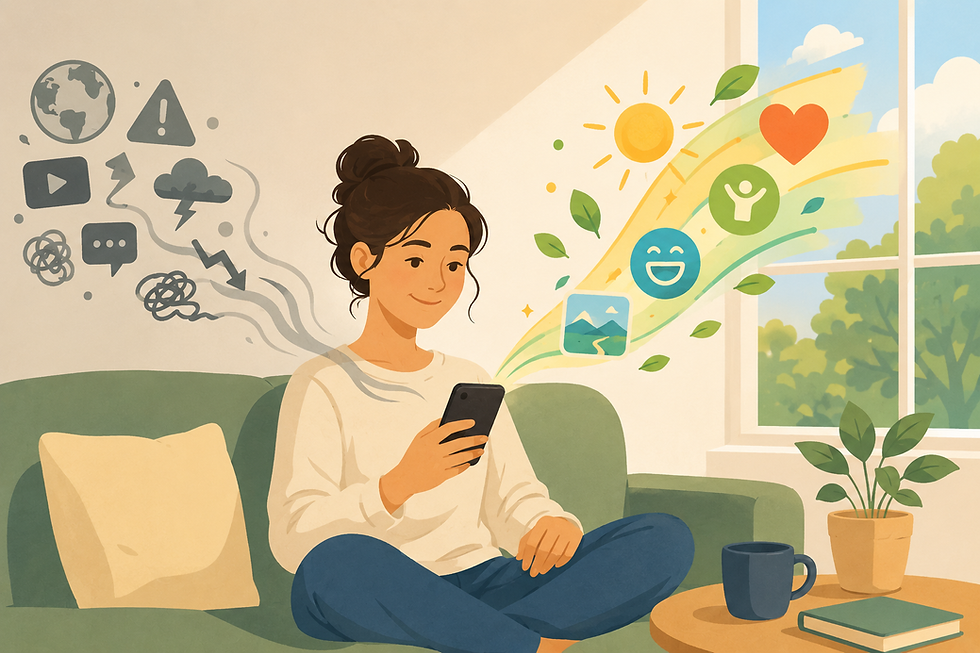
How Our Body Reacts to Doomscrolling
The brain's threat-detection system, the amygdala, is built to react fast. It scans incoming information for anything that could matter to survival and triggers a calculated response. Cortisol and adrenaline release into the bloodstream, heart rate climbs slightly, our breath shortens, blood vessels constrict, and the prefrontal cortex that handles our conscious thinking gets partially overridden as the body prioritizes reactivity over reflection. This system evolved for occasional threats that resolve quickly, like a snake in the grass or a noise behind us. When things were simpler, our body either fired up and ran or recognized the cue as harmless and disregarded it within seconds.
A feed full of stressful content doesn’t trigger the same response. It can deliver hundreds of micro-threats, none of which we can act on and none of which our brain is able to easily resolve, all arriving at a rate the algorithm has learned will hold our attention. We have a steady stream of small, unresolvable signals that lead to a low-grade fight-or-flight state that never gets the cue to turn off.
Our nervous system struggles to tell the difference between something happening to us and something we're only watching happen. Our negativity bias, which is the same one that kept our ancestors alive by directing attention toward potential danger before everything else, is what makes us click on the next headline. Each negative word in a headline measurably increases click-through rates, which means platform algorithms have learned to surface negativity because it works. A threat-detection system that was supposed to fire occasionally is now being fed by a system optimized to keep it firing.
The consequences are likely recognizable. Maybe we feel scattered for an hour afterward. Maybe we're irritable with someone who didn't deserve it. Maybe we can't fall asleep, then sleep poorly when we do. The next morning, we might feel preemptively defensive about things that haven't happened yet. Many of these feelings are hard to connect to the original cause or are easily explained away, which is why they rarely get traced back to the feed.
Feeling Our State
What's really happening here is a state shift. It’s considered the “fast-moving variable,” which in this case just means how activated our nervous system is right now, how much cortisol is circulating, and how readily our threat system is firing. Capacity is what we call the “slow-moving variable,” which refers to the reserve and resilience built up over months and years of sleep, training, recovery, steady relationships, and various other factors. The two get confused all the time.
A bad scroll session here and there shifts state without damaging our capacity, as long as it doesn’t become habitual. Both state and capacity can be restored, but they require different timelines. Changing either though requires changing the kind of signal our nervous system is being asked to process.
Doom and Hope
A 2025 study of about a thousand people compared watching a few minutes of an inspiring video, a few minutes of comedy, a few minutes of meditation, and no media at all. The inspiring content group, watching 3 to 5 minute clips of people overcoming tough odds, came out with more hope and lower stress over the following ten days. The effect was on par with meditation. Comedy didn't move the needle on hopefulness, but it did have its own stress-reducing effects through a different pathway.
There's also a body of work on what positive emotions do to us physically. When we’re stressed, watching even a short clip that elicits warmth or laughter returns our system to baseline faster than neutral content does. Positive emotion has a physiological signature, impacting our HRV and recovery time.
The mechanism appears to work in two directions. Hope narrows the gap between where we are and where we want to be, which engages our systems responsible for chasing our goals and finding motivation. The positive emotional response itself helps soften cortisol's grip and gives the prefrontal cortex more room to operate.
Behaviorally, the change usually shows up small but real. Maybe we follow through on something that we’ve been putting off or we're a little more patient with someone we'd usually snap at. The effort itself doesn't feel any less hard, but our body has extra energy to allocate that would’ve otherwise been consumed by the doom abyss.
Designing Better Inputs
Social media is an input stream, and our nervous system responds to whatever stream it gets. A diet that's 90% micro-threat content naturally leads to higher stress. A diet that includes regular exposure to people who overcame something, a heroic story, or an unexpected act of care can provide a buffer against the negative.
Hope is a lever we can actively pull to change our state. The hard realities don't get smaller because we watched a three-minute video about someone climbing a mountain with one functioning lung, but the residual effects stick with us and compound. The drift back into doomscrolling will likely happen anyway, but if we can integrate positive content with the negative, our body will thank us.
References
Buchanan, K., Aknin, L. B., Lotun, S., & Sandstrom, G. M. (2021). Brief exposure to social media during the COVID-19 pandemic: Doom-scrolling has negative emotional consequences, but kindness-scrolling does not. PLOS ONE, 16(10), e0257728. https://doi.org/10.1371/journal.pone.0257728
Fredrickson, B. L., & Levenson, R. W. (1998). Positive emotions speed recovery from the cardiovascular sequelae of negative emotions. Cognition and Emotion, 12(2), 191-220. https://doi.org/10.1080/026999398379718
Fredrickson, B. L., Mancuso, R. A., Branigan, C., & Tugade, M. M. (2000). The undoing effect of positive emotions. Motivation and Emotion, 24(4), 237-258. https://doi.org/10.1023/A:1010796329158
Fryburg, D. A., Ureles, S. D., Myrick, J. G., Carpentier, F. D., & Oliver, M. B. (2021). Kindness media rapidly inspires viewers and increases happiness, calm, gratitude, and generosity in a healthcare setting. Frontiers in Psychology, 11, 591942. https://doi.org/10.3389/fpsyg.2020.591942
Nabi, R. L., Demetriades, S., Walter, N., & Qi, L. (2022). Can a video a day keep stress away? A test of media prescriptions. Health Communication. https://doi.org/10.1080/10410236.2022.2134700
Nabi, R. L., Wang, M., & Ekeler, B. (2025). Media versus meditation: A comparison of the stress-relieving benefits of multiple media experiences. Psychology of Popular Media.


