


What is AI Anxiety?
The shorthand for what a lot of us might be feeling has become "AI anxiety," which naturally implies fear at the core of it. AI anxiety is now a measurable category in the research, with validated scales and a growing body of survey work tracking it across populations. What gets measured is something more nuanced than fear of the technology itself…it’s more of a physical and mental response to a unique kind of uncertainty that doesn't sit cleanly inside a known framework. It’s a beast of its own.
The Psychological Structure
When this thing gets studied carefully, it doesn't come out as one feeling. It's more like several related concerns that show up together and overlap.
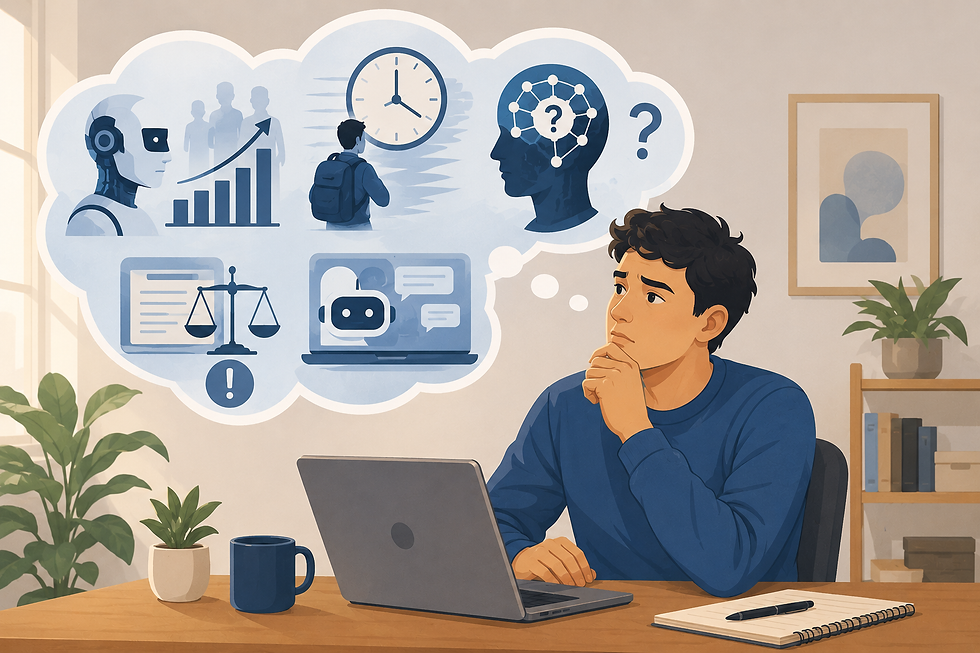
The most familiar one is about work and the worry that what we're doing now is going to be done by something else, sooner or with less warning than we'd want. Sitting close to that is a different and quieter worry, maybe less about replacement and more about pace. There seems to be a general sense that capability is moving faster than the time we have to learn it, so falling behind becomes its own kind of risk. Underneath both of those is something harder to put words to, but as an attempt to describe it, it’s a low-level discomfort with the fact that decisions are being made about systems whose behavior nobody seems to fully understand, including the people building them. Running through all of these is the philosophical thread of what intelligence actually is, what human judgment is for, what happens when more of it gets handed off.
These don't sit cleanly inside the categories we already had for technology anxiety or really anxiety overall. What’s called computer anxiety, which is the version studied heavily in the 1990s, mostly tracked discomfort with operating an unfamiliar tool. The discomfort here is a bit different, as AI systems aren't unfamiliar in the way a spreadsheet was unfamiliar. They generate, decide, respond, and simulate judgment. Whatever we're worried about, it isn't user-interface friction.
Exploring the Deeper Levels of AI Anxiety
The mental architecture matters because it shapes our physical response, and the physical response is what makes this hard to come to terms with.
The amygdala, which is the brain's threat-detection center, doesn't respond to abstractions like "the future of work." It responds to signals it can read as threat, and what it reads as threat is uncertainty about something important that we can't fully see, predict, or do anything about. The neurobiology of anxiety has converged on this point over the last decade, where anxiety is what the brain produces when it's anticipating a possible threat without enough information about the shape or timing of it.
When our brain runs that loop, several things shift at once. The estimates it produces for the impacts and probability of bad outcomes drift more pessimistic even if the evidence doesn’t necessarily point that way. Our attention narrows toward anything that might count as a relevant signal, and the bar for what counts as relevant drops. The circuitry between the amygdala and the part of our brain that normally helps us learn that ambiguous cues are relatively safe until proven otherwise struggle to communicate. Our system stays activated longer than the situation calls for, partly because there isn't really a situation to stop responding to.
That kind of sustained activation has a metabolic signature that we’ve continually explored in other articles. Cortisol release flattens but doesn't switch off. Glucose and attention keep getting routed toward keeping us activated but never fully recover. Our sleep shifts negatively, especially the cycles that handle memory consolidation and emotional processing. HRV, which gives us a reasonable read on how well the autonomic nervous system is recovering between demands, tends to drop as the weeks roll by.
Why AI Doesn't Fit the Usual Kind of Change
Previous waves of workplace change came with rougher edges. The factory worker in the 1980s could see the automation arriving, even if the timeline wasn't clear. The print journalist in the 2000s could watch the advertising base erode. The threat in those cases was real, and the response was often costly, but the lines were legible enough that our threat system had something concrete to work with.
AI introduces ambiguity at every level at once. Nobody really knows which tasks get folded in, which roles compress and how fast, whether the skills we've spent a decade building still hold their value, or whether the value quietly moves to skills we haven't started building yet. It’s tough to digest the idea that the field we trained for might not exist in five years in any form we'd recognize. The people closest to the technology don't agree on the answers, and a lot of them are saying so openly.
For a threat-detection system, this is about as close as we get to an ideal trigger for chronic stress. The threat is real enough to register but vague enough to evade a response that turns it off, and it's prolonged enough that we don’t get a chance to recover unless we tackle it directly and accept that it’s okay to not know.
Where to Move From Here
Giving something a name and understanding why it’s happening can help, but it doesn’t mean that our perception of the threat just disappears. The conditions producing it are real, and they aren't going to clarify themselves on a useful timeline. What has to change is how we perceive AI and its implications. The source of the anxiety is our threat-anticipation system doing what it does when asked to monitor something we can't resolve.
The science is still working out what to make of it, but that's a different framing than the assumption that something has gone wrong already. By recognizing that we see AI as a threat, we naturally start to gain control over our mind and can paint it in a different light; at least, until more data comes to help us reshape our perspective.
References
Blanchard, D. C., & Canteras, N. S. (2024). Uncertainty and anxiety: Evolution and neurobiology. Neuroscience & Biobehavioral Reviews, 162, 105732. https://doi.org/10.1016/j.neubiorev.2024.105732
Holley, D., Varga, E. A., Boorman, E. D., & Fox, A. S. (2024). Temporal dynamics of uncertainty cause anxiety and avoidance. Computational Psychiatry, 8. https://doi.org/10.5334/cpsy.105
Kaltenegger, H. C., Marques, M. D., Becker, L., Rohleder, N., Nowak, D., Wright, B. J., & Weigl, M. (2024). Prospective associations of technostress at work, burnout symptoms, hair cortisol, and chronic low-grade inflammation. Brain, Behavior, and Immunity, 117, 320–329. https://doi.org/10.1016/j.bbi.2024.01.222
Uğur, N. G., & Dursun, F. (2025). The social anatomy of AI anxiety: gender, generations, and technological exposure. Frontiers in Psychiatry, 16, 1641546. https://doi.org/10.3389/fpsyt.2025.1641546
Zheng, J., & Zhang, T. (2025). Association between AI awareness and emotional exhaustion: The serial mediation of job insecurity and work interference with family. Behavioral Sciences, 15(4), 401. https://doi.org/10.3390/bs15040401
Wang, Y. Y., & Wang, Y. S. (2022). Development and validation of an artificial intelligence anxiety scale: An initial application in predicting motivated learning behavior. Interactive Learning Environments, 30(4), 619–637. https://doi.org/10.1080/10494820.2019.1674887


