


What is Nervous System Dysregulation?
The term can get used to describe being wired at 2am but also being foggy at 2pm. It might get applied to tearing up at a coffee shop or snapping at someone over nothing. These don't seem like the same thing, and they aren’t on the surface, but they all point back to the same system.
"Nervous system dysregulation" has become catch-all language, applied to whatever's not going well in the body. The problem with catch-all language is that it’s accurate but broad and stops really describing anything useful. The phenomenon underneath though is well-studied, and it’s more specific than the way the term tends to get used.
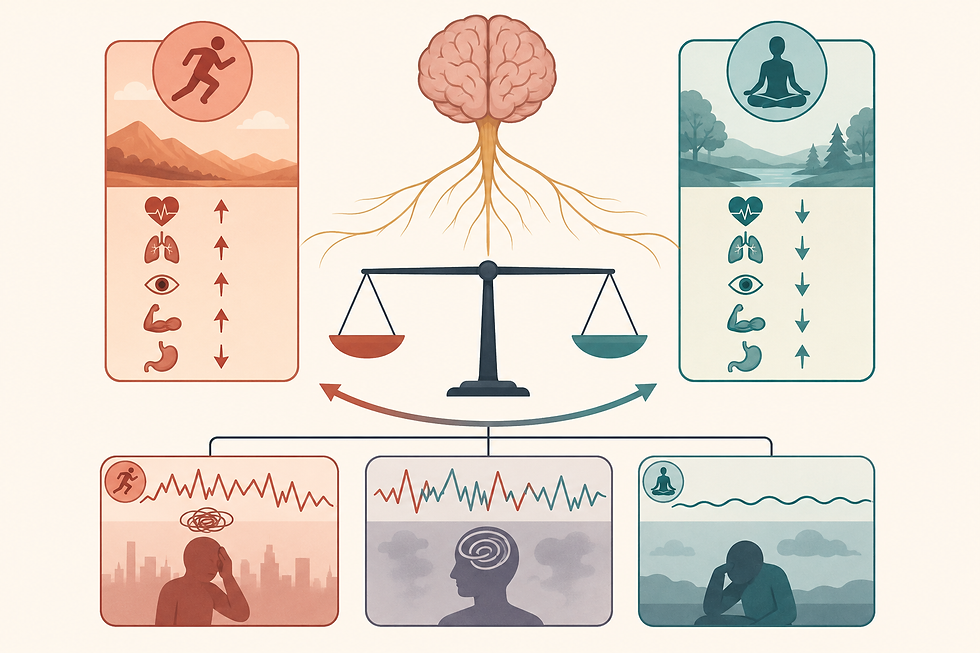
What’s Happening to Us?
The part of the nervous system we’re talking about here is the autonomic branch, which is the half that runs without conscious input. It handles heart rate, breathing depth, digestion, pupil dilation, body temperature, the loosening or tightening of muscles around the gut, etc. The autonomic system controls these for us, and it's constantly responding to what it perceives is happening around us.
It has two main modes that work in opposition. The sympathetic branch ramps things up, what we usually call "fight or flight," though that's a narrow slice of what it actually does. It speeds up heart rate, sharpens vision, pulls blood toward large muscles, releases adrenaline and cortisol, just to name a few. It's the system that gets us moving and gets us ready. The parasympathetic branch does the opposite. It slows the heart, deepens the breath, supports digestion, signals that we’re safe, etc. We need both to live, and neither is good or bad. We’re built to move between them fluidly in response to what's actually happening around and inside us. That fluidity is what gets lost when we become “dysregulated.”
Underneath Nervous System Dysregulation
When researchers describe nervous system dysregulation, what they're usually pointing at isn't a single direction of imbalance. It's a loss of flexibility in that our system stops moving between states the way it's supposed to. Someone whose sympathetic branch ramps up at a minor email and then can't come back down for hours is dysregulated. Another person whose parasympathetic system pulls them into shutdown (i.e. feeling flat, foggy, and distant) when the situation calls for engagement is also dysregulated. So is someone who oscillates between the two without ever landing in the middle ground.
This is why the popular usage of the terms covers states that might look contradictory, but being wired or shutdown come from the same place. They're two ways the same underlying system fails to do its job, which is to match our internal state to our actual context.
HRV is the most reliable metrics we have to help understand how our nervous system is doing. A flexible nervous system produces a lot of variability and a stuck one produces less. Vagal tone, which is the influence of the vagus nerve on our heart and gut, tracks closely with this. Higher vagal tone generally indicates a parasympathetic system that can engage when needed and step back when it isn't. Blunted vagal response, meaning the system not coming online when it should, is one of the main culprits of dysregulation.
Another underlying cause for dysregulation is sympathetic dominance, where our body sits in a low-grade stress state most of the time. When this is the case, heart rate stays slightly elevated, sleep is a little fragmented, and our gut be a bit inflamed. None of it is dramatic enough in the short term to feel like a crisis, but our system is never really resting.
How This Impacts Our Life
In day-to-day, autonomic inflexibility shows up in patterns that have nothing to do with how someone thinks they're doing. Feelings can range from lying in bed exhausted but unable to sleep, to waking up at 4am feeling constricted and anxious. It can also take the shape of feeling fine, then suddenly furious, with no clear handoff between the states, going emotionally flat in the middle of an argument that “should” have us heated, eating a normal meal and feeling sick from it, or even having a fine day on paper and feeling like the the world is crumbling around us. Dysregulation can have a massive range of impacts that are highly individualized yet still share the same root cause person to person.
The pattern that ties these together is the mismatch. Our internal state doesn't match what's happening around us. We're activated when the room is calm, or we're shut down when the moment calls for presence. The signals are off, not necessarily too strong or too weak, just out of phase with reality.
The autonomic nervous system learns from the past, and that’s often the driver behind losing flexibility. Chronic stress, sustained sleep deprivation, sustained social pressure, and sustained inflammation all shift our baseline functions and what we consider our “normal.” Rather than calibrating to the current moment, our body starts running on the average of the last several months. The activation that made sense during a hard quarter at work outlasts the quarter. The shutdown that protected us during a difficult relationship persists after the relationship ends. The body is responding to a context that's no longer there.
Navigating the Complexity
What gets called dysregulation is most accurately described as inflexibility. Our system has lost the ability to track context in real time and is instead running on a stuck setting that’s sometimes too high and sometimes too low. We start to lose our balance.
The reason this matters has less to do with self-diagnosis and more to do with what we're trying to understand about ourselves. A system that has lost flexibility doesn't need to be “calmed” or “activated;” It needs to recover the ability to move between states and response to what's actually happening. That's a different goal than "regulating," and it points somewhere different than the catch-all language suggests.
Most of what wellness culture has filed under nervous system dysregulation is real, but it’s been compressed into a label that hides the actual mechanism that’s necessary to address the problem. Luckily, we’re not broken if we get dysregulated, we’re just stuck and need the right tools to reset.
References
Porges, S. W. (2007). The polyvagal perspective. Biological Psychology, 74(2), 116–143. https://doi.org/10.1016/j.biopsycho.2006.06.009
Thayer, J. F., & Lane, R. D. (2009). Claude Bernard and the heart-brain connection: Further elaboration of a model of neurovisceral integration. Neuroscience & Biobehavioral Reviews, 33(2), 81–88. https://doi.org/10.1016/j.neubiorev.2008.08.004
Laborde, S., Mosley, E., & Thayer, J. F. (2017). Heart rate variability and cardiac vagal tone in psychophysiological research – recommendations for experiment planning, data analysis, and data reporting. Frontiers in Psychology, 8, 213. https://doi.org/10.3389/fpsyg.2017.00213
McEwen, B. S. (2007). Physiology and neurobiology of stress and adaptation: central role of the brain. Physiological Reviews, 87(3), 873–904. https://doi.org/10.1152/physrev.00041.2006
Beauchaine, T. P., & Thayer, J. F. (2015). Heart rate variability as a transdiagnostic biomarker of psychopathology. International Journal of Psychophysiology, 98(2), 338–350. https://doi.org/10.1016/j.ijpsycho.2015.08.004
Kemp, A. H., & Quintana, D. S. (2013). The relationship between mental and physical health: Insights from the study of heart rate variability. International Journal of Psychophysiology, 89(3), 288–296. https://doi.org/10.1016/j.ijpsycho.2013.06.018


